Sunday, September 27, 2026
Home Blog Page 3832

Preventing the death of the world’s rivers

0

The world’s rivers are under unprecedented pressure from contamination, damming, and diversion, which are straining water resources, destroying ecosystems, jeopardizing livelihoods, and damaging human health. International cooperation can save riparian systems, but first we must recognize the consequences of doing nothing.

By Brahma Chellaney
From the Tigris to the Indus and the Yangtze to the Nile, rivers were essential to the emergence of human civilization. Millennia later, hundreds of millions of people still depend on rivers to quench their thirst, grow food, and make a living. And yet we are rapidly destroying the planet’s river systems, with serious implications for our economies, societies, and even our survival.
China is a case in point. Its dam-building frenzy and over-exploitation of rivers is wreaking environmental havoc on Asia, destroying forests, depleting biodiversity, and straining water resources. China’s first water census, released in 2013, showed that the number of rivers – not including small streams – had plummeted by more than half over the previous six decades, with over 27,000 rivers lost.
The situation has only deteriorated since then. The Mekong River is running at a historically low level, owing largely to a series of Chinese-built mega-dams near the border of the Tibetan Plateau, just before the river crosses into Southeast Asia. In fact, the Tibetan Plateau is the starting point of most of Asia’s major rivers, and China has taken advantage of that, not least to gain leverage over downstream countries.
China may be the world’s largest dam builder, but it is not alone; other countries, from Asia to Latin America, have also been tapping long rivers for electricity generation. The diversion of water for irrigation is also a major source of strain on rivers. In fact, crop and livestock production absorbs almost three-quarters of the world’s freshwater resources, while creating runoff that, together with industrial waste and sewage discharge, pollutes those very resources.
In total, almost two-thirds of the world’s long rivers have been modified, and some of the world’s longest – including the Nile and the Rio Grande – now qualify as endangered. Of the 21 rivers longer than 1,000 kilometers (620 miles) that still flow freely from their mountain sources to the sea, most are in remote regions of the Arctic and in the Amazon and Congo basins, where hydropower development is not yet economically viable.
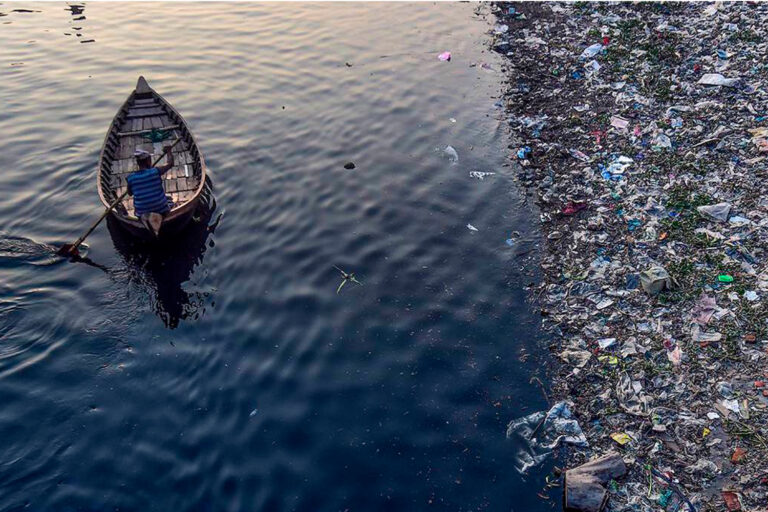
These trends strain water resources, destroy ecosystems, and threaten human health. For example, heavy upstream diversions have turned the deltas of the Colorado River and the Indus River into saline marshes. Moreover, lower river-water levels impede the annual flooding cycle, which in tropical regions helps to re-fertilize farmland naturally with nutrient-rich sediment. In periods of below-average rainfall, a number of rivers increasingly run dry before reaching the ocean, and even when they do make it, they are depositing less of the nutrients and minerals that are vital to marine life.
Globally, aquatic ecosystems have lost half of their biodiversity since the mid-1970s, and about half of all wetlands have been destroyed over the last century. A recent United Nations study warned that up to a million animal and plant species are threatened with extinction, many within decades.
Humans are hardly exempt from the health consequences of river destruction. In Central Asia, the Aral Sea has all but dried up in less than 40 years, owing to the Soviet Union’s introduction of cotton cultivation, for which water was siphoned from the sea’s principal sources, the Amu Darya and Syr Darya rivers. Today, particles blown from its exposed seabed – thick with salts and agricultural chemical residue – not only kill crops; they are sickening local people with everything from kidney disease to cancer.
Free-flowing rivers play a critical role in moderating the effects of climate change, by transporting decaying organic material and eroded rock to the ocean. This process draws about 200 million tons of carbon out of the air each year.
In short, the case for protecting our rivers could not be stronger. Yet, while world leaders are often willing to pay lip service to the imperative of strengthening river protections, their rhetoric is rarely translated into action. On the contrary, in some countries, regulations are being rolled back.
In the United States, almost half of rivers and streams are considered to be in poor biological condition. Yet last October, President Donald Trump’s administration repealed “Waters of the US,” which had been introduced by his predecessor, Barack Obama, in order to limit pollution of streams, wetlands, and other bodies of water. Last month, the Trump administration replaced the rule with a far weaker version, called the “Navigable Waters Protection Rule.”
Likewise, in Brazil, President Jair Bolsonaro has relaxed environmental rules in the name of economic growth. Among the casualties is the Amazon River, the world’s largest river in terms of discharge, which carries more water than the next ten largest rivers combined. Already, the Amazon basin in Brazil has lost forest cover over an area larger than the entire Democratic Republic of Congo – the world’s 11th-largest country.
The absence of water-sharing or cooperative-management arrangements in the vast majority of transnational river basins facilitates such destruction. Many countries pursue projects without regard for their cross-border or environmental effects.
One way to protect relatively undamaged river systems – such as the Amur, the Congo, and the Salween – would be to broaden implementation of the 1972 World Heritage Convention, and add these rivers to the World Heritage List, alongside UNESCO World Heritage Sites. This would be in line with recent efforts in some countries – Australia, Bangladesh, Colombia, India, and New Zealand – to grant legal rights to rivers and watersheds. For such initiatives to work, however, effective enforcement is essential.
As for the rivers that are already damaged, action must be taken to restore them. This includes artificially recharging rivers and aquifers with reclaimed wastewater; cleaning up pollution; reconnecting rivers with their floodplains; removing excessive or unproductive dams; and implementing protections for freshwater-ecosystem species.
The world’s rivers are under unprecedented pressure from contamination, damming, and diversion. International cooperation can save them, but first we must recognize the consequences of doing nothing.

Brahma Chellaney, Professor of Strategic Studies at the New Delhi-based Center for Policy Research and Fellow at the Robert Bosch Academy in Berlin, is the author of nine books, including Asian Juggernaut, Water: Asia’s New Battleground, and Water, Peace, and War: Confronting the Global Water Crisis.


Fikrte Gebre

0

Name: Fikrte Gebre

Education: 10+2

Company name: Weynshet and Fikrte Bamboo Works Plc

Title: Founder

Founded in: 2018

What it does: Manufacture different kinds of bamboo products

HQ: Addis Ababa

Number of employees: 3

Startup Capital: 1,500 birr

Current capital: 100,000 birr

Reasons for starting the business: Our experience in the business

Biggest perk of ownership: Having a strong goal

Biggest strength: Risk taker

Biggest challenging: A place to work

Plan: To build strong company

First career: House maid in Arab countries

Most interested in meeting: Tewodros Kassahun

Most admired person: My mother

Stress reducer: Praying

Favorite past time: Family time

Favorite book: “Fikir Eske Mekabr” Hadis Alemayehu

Favorite destination: Any places which I can have fun

Favorite automobile: Pick Ups

Africa Arise – ACT

0

This week saw the 11th conference titled “Africa Arise”, organized by Beza International Church in cooperation with members of the diplomatic community in Addis Abeba. This conference takes place just prior to the annual African Union meeting and has become an annual event since the first one took place eleven years ago. Since then it is attended by an increasing number of Christian leaders, diplomats and politicians from all over Africa and from other parts of the world.
During the conference, important issues affecting Africa are discussed and solutions are suggested from the Christian and biblical perspectives. Issues include economic development, resources management, corruption, security and conflict, major contemporary issues in other words.
The conference takes place over three full days, with deliberations during the morning and a church service every evening during which Christian leaders from several different African countries speak.
Just prior to the opening of the annual assembly of the African Union, an early morning is traditionally dedicated for a prayer breakfast in one of the halls at the new Africa Union offices.
This year’s theme was ACT: Act for Peace and Reconciliation; Act for Unity; Act for the Kingdom Mission and Act for Global Leadership.
A week before this year’s conference, members of the business community were invited to discuss what it means to do business in an ethical way, in the context of corruption, being Africa’s greatest enemy to growth and development. Corruption can be compared to a disease, which deflates the tires of progress, bringing it to a halt. Corruption is moral problem. It is a disease of the heart. And though governments try their best to combat corruption by tabling heavy legislation, they have a hard time doing so exactly because of the fact that it is an issue of morality and integrity.
To support the fight against corruption it is suggested that the church is in a position to help. What Beza International Church has done for example is develop an ethical charter and encourage business professionals to commit to it. They are expected to take a stand in their places of business against all forms of corruption- zero tolerance for bribery, fair treatment of all employees, faithfulness to customers and clients and faithfulness to government regarding all tax obligations. By signing up to this ethical charter, they are now kept accountable to this because they are embedded in the foundations of the church, a great service to the development of the nation.
This initiative was again shared to the business people, attending the conference and who came from across the continent. It will indeed be hard for Africa to move forward without addressing this all- important issue of corruption. The plan is to collect a database of businessmen and -women, who have committed themselves to the ethical standards across the continent. Typically, Ethiopia does not do business with Nigeria, Nigeria does not do business with Zambia, and Zambia does not do business with Kenya. Why? Because wherever corruption is high, trust is low. But an ethical charter rooted in the fear of God will address this trust problem and thus the corruption problem.
A smart phone app will list the businesses of Africa who have committed themselves to the ethical charter, opening up Africa for clean business connections. The app will also include a rating system, so that clients can report cases where the standards of the ethical charter have not been upheld, for all the world to see. It will serve as a further accountability check. Corruption goes down, trust goes up and Africa will open up for business, is the logic.
Indeed, we must ACT and step up to the challenges and opportunities that this continent offers. It can be done but it must be done in a way that sustains the environment and in a way that is fair and decent and does not exploit workers, children or the poor. There are many business opportunities indeed but very often business is done, with the aim in mind to make profit in a short time, using short cuts and doing harm to people and the environment.
Instead we need to do business with integrity and in an ethical way, in a way that is good and right, as opposed to bad or wrong. Is it ethical, for example, to pay a bribe to obtain a business contract? Is it ethical to dispose of hazardous waste in an unsafe manner? Is it ethical to withhold information that would discourage a potential partner to join your business? Is it ethical to ask somebody to do a job, which you know will not be good for his or her health? Is it ethical to underpay workers? Is it ethical to expect certain favours from workers outside of their job description? Is it ethical to deliver below standard goods and services? Is it ethical to deliver below capacity?
May I suggest that business owners and professionals in Ethiopia and across the continent join this initiative and together step up to the challenge to fight corruption and by doing so truly advance the growth and development of Africa. ACT!

Ton Haverkort
ton.haverkort@gmail.com

The growing issue of technology theft

0

Noted political analysts asserted that Chinese-Russian military and geopolitical cooperation is flourishing for now. And that has the United States worried. However, if the weapons industry is anything to go by, a fraying at the edges of close ties between the two Asian powers may be on the horizon. To be sure, Russia remains by far China’s foremost arms supplier. But that doesn’t keep China from stealing Russian military technology, much like it allegedly does in the West.
So far, according to James Dorsey, an award-winning journalist and a senior fellow at the S. Rajaratnam School of International Studies in Singapore Russia, has been willing to look the other way. Equipped with a notoriously weak economy and a political regime that is desperately in need of the revenues of weapons sales, Russia had no real alternative option. Military sales undergird Russia’s geopolitical heft.
The question is for how long Russia can afford this benign, acquiescent attitude and look the other way when China steals military technology. By the same token, viewed in a broader strategic context, this is also a question that applies to various other opportunistic alliances. This notably includes the relationship between Russia, Turkey and Iran.
James Dorsey stated that what these relationships, often concluded to stand up to the United States, have in common is that they are driven by short-term interests. First and foremost, they reflect a desire to institutionalize a multipolar world in which United States power is counterbalanced by others. These alliances, adopting pragmatic approaches, have so far worked by focusing on immediate interests, while carefully managing significant differences. Those differences, nonetheless, surface regularly. Recently, alleged Chinese intellectual property theft as well as diametrically opposed Turkish, Russian and Iranian policies towards conflicts in Syria and/or Libya that have figured prominently in media reports.
This month, “Rostec”, the Russian State defense conglomerate, gave a rare public display of friction between Russia and China. It echoed long-standing United States allegations of Chinese technology theft and accused China of illegally copying Russian military hardware and weapons.
Yevgeny Livadny, Rostec’s Chief of Intellectual Property Projects, said: “Unauthorized copying of our equipment abroad is a huge problem. There have been 500 such cases over the past 17 years. China alone has copied aircraft engines, Sukhoi planes, deck jets, air defense systems, portable air defense missiles and analogues of the Pantsir medium-range surface-to-air systems”. It was clear that Mr. Yevgeny Livadny appeared to be referring among other things to alleged Chinese intellectual property theft after Russia sold to China in 2015 six S-400 anti-aircraft systems and 24 Su-35 fighter jets for 5 billion dollar.
Branko Milanovic, the Presidential Professor at the Graduate Center of City University of New York stated that China is thought to have benefitted from Russian technology when it in 2017 rolled out its fifth generation Chengdu J-20 fighter that is believed to be technologically superior to Russia’s SU-57E. Similarly, China is suspected of having based its J-11 fighter jet and HQ-9 surface-to-air missiles on Russia’s Su-27 fighter jets and S-300 missile systems purchased in the 1990s. Chinese technology theft is unlikely to persuade Russia any time soon to forego the strategic advantages of its geopolitical cooperation with China.
Russia needs to assert itself at some point
Branko Milanovic noted that with China’s defense industry significantly improving its technological capabilities, Russia needs to ensure that it remains crucial to the People’s Republic’s military development for economic reasons as well as in a bid to maintain a strategic balance in an alliance that is based on pursuing short-term common interests while kicking potential friction points down the road. When it comes to arms, Russia’s preferred strategy is to try pressuring China to engage in joint weapons development, while seeking to maintain a technological edge for itself.
According to Branko Milanovic, this was evident just recently, when Russia sought to press its technological advantage by announcing that its new Avangard Hypersonic Intercontinental Glide Vehicle that can fly 27 times the speed of sound had become operational. Positioning Russia as the first country to have hypersonic weapons, the Avangard is launched atop an intercontinental ballistic missile. However, unlike a regular missile warhead that follows a predictable path after separation, it can make sharp manoeuvres in the atmosphere en route to target, making it much harder to intercept.
In geopolitical terms, the Avangard missile may give Russia a first-starter advantage but at best is yet another band aid to work around the fragility of not only the Russian Chinese alliance, but also alliances like that of Turkey with Russia and with Iran.
Uwe Bott, Senior Defense and Economic analyst noted that the fragility of those alliances is evident in Turkish and Russian attempts to balance their competing interests in Syria and Libya. Turkey has criticized the ongoing Syrian-Russian assault on Idlib, the last Syrian rebel stronghold, and called for an immediate ceasefire.
According to Uwe Bott, Turkey and Russia are also at odds when it comes to Russian interference in Ukraine, the exploitation of natural gas reserves in the Eastern Mediterranean, the Azerbaijani-Armenian conflict in the Caucasus over Nagorno-Karabagh and they compete for influence in the Balkans and Central Asia. To be sure, Turkey’s and Russia’s presidents, Recep Tayyip Erdogan and Vladimir Putin, respectively, envision a Turkish and a Russian world that serve as spheres of influence. These are not only bound to clash but clash already.