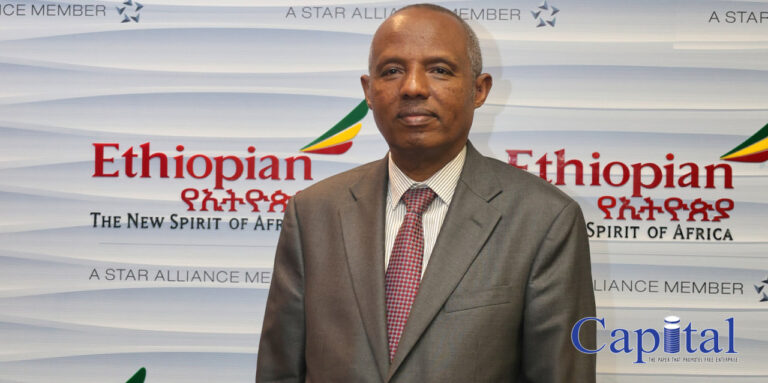
As geopolitical tensions in the Middle East disrupt global aviation, Ethiopian Airlines finds itself balancing immediate operational shocks with long-term strategic ambitions. In this wide-ranging interview with Capital’s Groum Abate, Group CEO Mesfin Tasew discusses the impact of airspace closures, volatile fuel prices, and aircraft shortages, while outlining the airline’s resilience, expansion plans, and vision for Africa’s largest aviation hub. Excerpts;
Capital: The recent escalation of geopolitical tensions in the Middle East has resulted in airspace closures over the Gulf region, mass flight cancellations, and highly volatile jet fuel prices. What has been the direct operational and financial impact of this conflict on Ethiopian Airlines and your business?
Mesfin: Unfortunately, the conflict in the Gulf and Middle East has been ongoing for the past three weeks, significantly affecting global business and the aviation industry. Several middle east countries have closed their airspaces, leading most airlines to cancel flights to this region. In Ethiopia, we had to suspend flights to eight countries and ten cities, including Lebanon, Israel, Jordan, Kuwait, Bahrain, Qatar, the United Arab Emirates, and, to some extent, Saudi Arabia. However, as the situation has improved in certain areas, we have resumed flights to Sharjah in the United Arab Emirates and Dammam in Saudi Arabia.
Currently, we have eight suspended flights, and our operations to these two cities are primarily focused on repatriation. This situation has significantly impacted us, resulting in a reduction in passengers and loss of revenue. Although it negatively affects our operations, it represents only a small portion of our global operations, so the overall impact is not catastrophic. Ethiopian Airlines is still performing well.
Capital: Fuel is typically the largest cost for airlines. Given the recent spike in oil prices due to the conflict, can you elaborate on Ethiopian Airlines’ current fuel hedging strategy?
Mesfin: Beyond the reduction in passengers, the most significant impact of the conflict on us has been the supply of fuel. The situation has disrupted fuel availability, which poses a major challenge. We are collaborating with our government to identify alternative sources of jet fuel. So far, we have been utilizing reserves available in Addis Ababa and Djibouti, which should sustain us for several days. We have made the necessary preparations to ensure our operations do not come to a halt due to jet fuel shortage.
The government has procured additional jet fuel from other sources, which is currently en route to Djibouti. We aim to prevent any gap between our reserve depletion and the arrival of new fuel.
Ensuring a continuous fuel supply is our primary risk at the moment. Additionally, as you may have noticed, the global oil price has surged from around $65 per barrel to over $100, representing a more than 60% increase. This spike will impact jet fuel prices, which we are seeing rise by over 100% in the market. If this trend continues, it will have a significant effect on our operations, but we remain hopeful that conditions will improve in the coming weeks.
Capital: IATA’s latest report indicates that global airline revenues may exceed $1 trillion for the first time, although growth remains uneven and long-term challenges persist. As the head of Africa’s largest aviation group, how do you perceive the mixed state of the global aviation market in the first quarter of 2026? What primary opportunities do you identify for the African market?
Mesfin: The air transport industry began its recovery from the impacts of COVID-19 about two to three years ago and has continued to grow, with IATA reporting that the industry transported five billion passengers annually. A modest growth rate of around 4% is forecasted for 2026.
Over the past three years, demand for air transport has risen, and the industry has worked to accommodate this increase. While growth has been positive, the rate is now leveling off at a slower pace.
As you mentioned, the airline industry overall has been profitable in the last three years, with IATA reporting a profitability of approximately $39.5 billion in 2025. However, the situation varies across airlines—some are profitable while others continue to operate at a loss. Airlines that have the right strategies and the capacity to implement them are seeing significant profits, whereas several, particularly in Africa, are still struggling.
For Ethiopian Airlines, we have remained profitable, recording record profits over the past two to three years. Up until the first half of this fiscal year, which ended in December, we sustained strong growth and profitability. We are performing very well.
Capital: Currently, the Ethiopian fleet comprises 170 aircraft, but you’ve previously mentioned that aircraft shortages hinder expansion. With global manufacturers facing delivery delays, how do you reconcile your ambitious growth targets with these constraints?
Mesfin: We have an ambitious growth strategy, referred to as Vision 2035, which entails adding new routes, increasing flight frequencies, acquiring new aircraft, and expanding our operations annually. We have made progress, with our fleet currently standing at around 170 aircraft, including those used by our partner airlines.
If we didn’t face aircraft shortages, we could operate more planes, enhancing growth not only for Ethiopian Airlines but also for our partner airlines. Unfortunately, aircraft shortages have limited our expansion in line with our Vision 2035 strategy.
The critical shortage we face is primarily in wide-body aircraft capable of carrying more passengers and flying longer distances. In contrast, our narrow-body aircraft situation is manageable; we are still receiving new orders from Boeing, albeit slowly, and our regional routes are performing well.
Our main challenge lies with wide-body aircraft, such as the 777, A350, and 787 models, which are experiencing delivery delays. We anticipate starting to receive new aircraft deliveries in the second half of 2027.
In the interim, we will face about a year and a half of challenges related to this shortage. However, once we overcome this period, we expect a significant increase in wide-body aircraft deliveries each year, with a particularly large influx anticipated in 2029. Until then, we are actively seeking opportunities in the market to lease or purchase airplanes from current owners rather than directly from manufacturers.
For instance, in 2025, we acquired two Airbus A350 aircraft from China to help close the gap we have with our 787 airplanes. While we may not grow as much as outlined in our Vision 2035, we are focused on minimizing this gap through various strategies. One approach is to increase the utilization of our existing fleet.
For example, if our planes previously operated for 14 hours a day, we aim to extend that to 16 hours or more. By enhancing the utilization of our current aircraft and exploring leasing opportunities, we are striving to maintain growth, even if it falls slightly short of our Vision 2035 targets. The positive aspect is that this is a short-term adjustment, and we believe we will return to our planned growth trajectory.
Capital: What plans do you have to upgrade or overhaul your domestic flight aircraft?
Mesfin: We are dedicated to enhancing our domestic operations as the only scheduled operator in the country, and we recognize that Ethiopians rely on us. We firmly believe that air transport is crucial for the socio-economic development of our nation.
We view this responsibility as a national duty and are committed to improving domestic operations. To this end, we are constructing new airports to provide access to citizens who previously lacked such opportunities.
Currently, we are building five new airports: Negele Borana, Gore Metu , Mizan Aman, and Debre Markos. These are expected to be completed and operational within the next two months, increasing the total number of domestic airports from 23 to 27. Ethiopian Airlines has invested significantly in developing these new airports.
Additionally, we are modernizing airport facilities by constructing new passenger terminals, upgrading existing facilities, and expanding airport aprons. This is another area where we are making substantial investments.
Moreover, we currently operate around 28 Q400 turboprop airplanes along with a few Boeing 737 aircraft for domestic air transport. However, we are now assessing jet aircraft to gradually replace some Q400s and modernize our domestic fleet to provide enhanced service within the country. Improving domestic operations is a strategic goal for us, and we are actively working on it.
Capital: The new Bishoftu International Airport project employs an innovative financing model with a special purpose company to protect the airline’s balance sheet. With $700 million already invested, how confident are you in securing the remaining $9 billion in debt financing from partners given the current global economic uncertainty?
Mesfin: We need to approach this in two phases. The first phase involves the development of Bishoftu International Airport, a strategic project for us. Before proceeding, we engaged a consultant to conduct a detailed feasibility study.
This feasibility study includes a traffic forecast, assessing whether traffic at Bishoftu International Airport will grow, how many passengers will use it, and the revenue it will generate. It also outlines the costs required to build and operate the airport. The study conclusively demonstrated that the new airport would be highly profitable on its own.
We shared this feasibility study with financiers worldwide and conducted numerous workshops and briefings. In every forum where we presented the study, financing institutions expressed significant interest in participating. This interest stems from two key points: first, the project is feasible, and second, it is recognized as an important African infrastructure development project.
Consequently, even African development banks have shown enthusiasm for raising funds and encouraging additional investors to come together for joint financing of this project.
All our activities thus far have indicated strong interest. Many financiers have begun conducting their own feasibility studies, as the study conducted by Ethiopian Airlines serves as just the starting point.
Each financier wants to validate our findings through their own processes, and they have already started this work.
However, in the last three weeks, we encountered a different situation. There is significant conflict in the Middle East Gulf, leading to uncertainty about its potential impact on the global economy. While we cannot predict the outcome, I believe this situation will be short-lived. In my opinion, it is only a matter of time before the global economy returns to normal, and I do not expect it to negatively affect our project.
Capital: The new airport is designed to handle 80% transit passengers, clearly aiming to compete with major hubs like Dubai and Doha. How does Ethiopia plan to differentiate itself and capture market share from these competitors with Bishoftu?
Mesfin: It is true that passengers traveling between Africa and the rest of the world utilize various hubs. Istanbul serves as a hub for Turkish Airlines, Doha for Qatar Airlines, and similar roles are filled by Emirates. Ethiopian Airlines has been using Addis Ababa as a hub to connect Africans globally.
However, when comparing Addis Ababa Airport to Dubai, Doha, Abu Dhabi, and Istanbul, we find that our airport is relatively small, and many passengers have been using Middle Eastern gateways to travel to Africa.
The new airport will be significantly larger and equipped with modern facilities and amenities equivalent to those enjoyed in the Middle East. As a result, it will offer services that are equal to or possibly better than those at existing hubs. This new airport will be highly competitive compared to Middle Eastern hubs.
Passengers consider not only airport facilities but also the airlines and connectivity at the airport. For instance, at some Middle Eastern hubs, connecting flights often involve long layovers—typically four to six hours. In contrast, at Addis Ababa airport, we have designed our schedule to ensure that most flights arrive within one to two hours and depart shortly after, allowing for faster connections compared to those hubs.
Our new airport, with its spacious and modern facilities, including duty-free shops and retail services featuring Ethiopian-made products, is poised to attract more passengers. We aim for Bishoftu International Airport to serve as a gateway between Africa and the rest of the world.
Additionally, this new airport will function as a hub for intra-African travel. Passengers from Johannesburg, for example, can easily connect through Addis Ababa to reach destinations like Lagos. This will draw many transit passengers and tourists to Ethiopia, driving growth in tourism, conferences, and investments.
Capital: What is the status of using clean energy in Ethiopian Airlines’ fleet?
Mesfin: When you mention reducing carbon emissions, we have implemented several measures to decrease our carbon footprint, starting with fleet modernization.
Our new aircraft are equipped with more fuel-efficient engines. For example, the A350 features the latest technology from Airbus with low carbon dioxide emissions, while the 787 is powered by highly efficient engines from General Electric and Rolls-Royce. Fleet modernization is a key strategy for reducing emissions.
Another area we are gradually enhancing is the use of sustainable aviation fuel (SAF). We have begun using SAF, but its limited availability at most airports has hindered our ability to utilize blended fuels. Currently, all our flights departing from Europe use only 2% SAF blended fuel, which is standard across the industry. We anticipate an increase in SAF production in the near future, which will allow us to enhance its use. Currently, no companies in Ethiopia produce SAF, but we are collaborating with those that are in the process of starting production. Progress is slow, but we expect SAF production to ramp up first in developed countries before expanding to developing nations.
Capital: Ethiopian Airlines has been a leader in gender inclusion in Africa, with women now comprising about 40% of your workforce. What specific policies or cultural shifts have contributed to this progress?
Mesfin: We have a policy of being an equal opportunity employer, providing equal chances to all Ethiopian citizens, regardless of gender. This commitment is clearly articulated in our policy, and we are actively implementing it.
In the past, certain professions were largely considered male-dominated. For instance, about ten years ago, although it wasn’t explicitly stated in our hiring policies, there was a prevailing tendency to hire only male pilots, resulting in an all-male pilot workforce.
However, around 15 years ago, we recognized the need to open all professions to individuals of any gender. Consequently, we began hiring more women, and now we have 95 female pilots out of a total of 1,600. While this still represents only about 5%, it is a significant improvement.
In our pilot training school, we now have several female students. We also previously believed that the physically demanding nature of aircraft maintenance would make it difficult for women to work as technicians. Yet today, we see women confidently using tools and successfully changing aircraft parts.
The number of female aircraft technicians has also risen. In management roles, we encourage women to take on greater responsibilities. Ethiopian Airlines promotes equal opportunity without differentiation or segregation, allowing our daughters and sisters to excel in all professions, including management.
Our approach is straightforward: the profession does not confer any special advantages to women. We do not engage in affirmative action; rather, we believe that if you are a pilot, you must safely fly the aircraft and meet competency requirements. We provide equal training and opportunities, but ultimately, competency is the key factor. Our experience shows that when given equal opportunities, female workers can perform as well as, or even better than, their male counterparts. Therefore, we believe they do not require special assistance, and this strategy has proven successful.
Capital: Any final comments?
Mesfin: Ethiopian Airlines is performing well and has consistently navigated challenging times. During such periods, our employees—both management and non-management—come together to develop new strategies that help the company adapt to difficult environments while achieving growth and profitability.
Despite the current challenges in the Gulf and Middle East, we are confident in our ability to remain strong and continue on our growth trajectory.
Every employee is committed to helping the airline overcome these challenges, so there is no major cause for concern. While it is indeed a challenge, we are confident we will emerge successfully.