

COP30 President André Corrêa do Lago has said this year’s conference must put “people at the centre” of climate action. But a network of fragile states says more than one billion of the world’s most at-risk people are still being left out of the conversation.
In a statement released on Tuesday, the Improved and Equitable Access to Climate Finance Network said that countries affected by conflict and fragility are being “locked out” of funding to adapt to climate impacts.
The Network – which is made up of 10 countries affected by fragile governance and conflict, including Burundi, Mauritania, Somalia and Papua New Guinea – is calling for climate funds and COP30 to do more to address “this urgent blind spot at the heart of climate finance.”
More than one billion people live in countries affected by conflict, violence and fragile governance. Yet in 2022 these countries received just 10% of global climate finance, despite being some of the most vulnerable to climate impacts.
Fragile states at the 30th Conference of the Parties (COP30): We are being ‘locked out’ of climate finance
Unlocking municipal finance for sustainable urban services and SDG success in Africa
African cities are engines of growth, yet many are operating far below their potential. Assessments conducted under a capacity development initiative led by the Economic Commission for Africa (ECA) and co-implemented with UN-Habitat and UNCDF, show that six target cities are functioning below 40 percent of their economic capacity. Strengthening municipal finance is essential to improving services in water, sanitation and waste management while moving faster towards the Sustainable Development Goals, especially SDG 11 on sustainable cities and communities.
Bridging the Municipal Services Gap
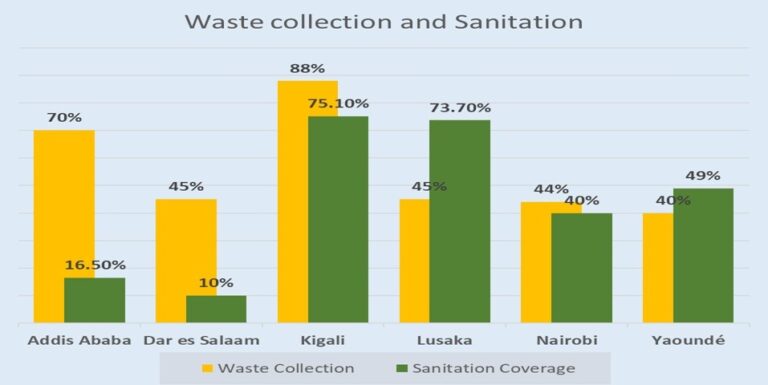
Service coverage varies widely across the cities studied, see the figure below.
These gaps show that strong municipal finance is not just a fiscal reform. It is a development necessity that allows cities to provide essential services effectively.
The Financial Reality in Africa
Global financial systems are struggling to meet Africa’s urban development needs. Rising public debt, climate risks, and stagnating official development assistance leave cities with limited resources. The capacity development initiative demonstrates that fully tapping local economic potential could generate substantial domestic revenue. These funds can support infrastructure, climate-resilient projects and SDG implementation.
Municipal Finance as a Catalyst for Progress
Local governments implement up to 65 percent of SDG targets globally. In Africa, this proportion is likely even higher due to rapid urban growth. International frameworks, from the Addis Ababa Action Agenda to the Sevilla Commitment, emphasize mobilizing domestic resources, strengthening municipal capacity and using innovative financing, including blended finance and municipal development funds. Effective municipal finance is central to attracting investment and building resilient urban economies.
Key Objectives for Expanding Municipal Finance
- Unlock Economic Potential: Modern digital finance systems that cover revenue collection and accounting increase transparency and build trust with citizens and investors.
- Enhance Service Delivery and Equity: Fiscal autonomy allows cities to raise local revenues, reduce reliance on central transfers and improve their creditworthiness.
- Build Economic Resilience: Cities can attract private investment and deliver sustainable, climate-resilient infrastructure through public-private partnerships.
Innovations in Action
Cities targeted by the capacity development initiative are currently piloting a range of smart solutions:
- Waste management: Addis Ababa’s Reppie Waste to Energy Plant converts waste into electricity through a public-private partnership.
- Water billing: Mobile and automated billing systems link water and waste fees, improving revenue collection.
- Community engagement: Kigali and Lusaka work with private operators and local enterprises to expand service coverage and strengthen revenue streams.
Challenges to Overcome
Municipal finance in Africa faces structural and institutional hurdles. Weak fiscal decentralization, outdated property registries, low tariffs, poor enforcement, and limited digital systems restrict cities’ ability to generate revenue. Low credit ratings and shallow capital markets also limit long-term investment. Specific city challenges, such as inadequate metering, fragmented institutions and informal practices, further reduce efficiency.
Policy Recommendations
Global level: Prioritize reforms to the global financial architecture, as they are essential for Africa’s development and for improving the financial health of its municipalities. These reforms would strengthen institutional frameworks, support more effective debt management at both national and local levels, and help countries mobilize development finance more efficiently and sustainably. In turn, this would give municipalities the resources they need to deliver essential services and advance inclusive local development. ECA is actively engaged in this area; for reference, see the 2024 publication The IMF and the Future of the Global Financial Architecture: A Report of the Africa High-level Working Group on the Global Financial Architecture.
- National level: Strengthen fiscal decentralization, provide predictable and flexible transfers, create municipal development funds to finance critical infrastructure, and update legal frameworks for borrowing and partnerships; and provide technical support.
- Municipal level: Modernize revenue collection through digital systems, invest in skilled staff, ensure transparent accounting practices, and develop bankable projects. Equally important is maintaining sound fiscal policies and management at the subnational level. Weak fiscal discipline in municipalities and regions can trigger subnational fiscal crises that, in turn, deepen national fiscal distress and worsen sovereign debt vulnerabilities. Experiences such as Argentina in the 2000s, as well as current concerns about the scale of local government debt in China, illustrate these risks.
- Innovative financing: Use blended finance, municipal bonds and guarantees to mobilize local capital. Governments can support with risk mitigation and technical assistance. These tools are most effective within a broader financing strategy and in countries with strong fiscal positions. Strengthening fiscal management, debt sustainability, and institutional capacity is essential to enabling innovative finance. Recent debt-for-nature swaps in Cabo Verde and the Democratic Republic of Congo (DRC) also show promise in easing debt pressures.
For further reading on ECA’s work in innovative finance, the Economic Report on Africa (ERA) 2020 provides an in-depth analysis of innovative financing mechanisms, along with other related ECA publications that examine their role in advancing Africa’s development.
Successful capacity development initiatives demonstrate the impact of these approaches. Linking waste fees to water bills in Addis Ababa, outsourcing waste collection in Kigali, and partnering with local enterprises in Lusaka have improved service coverage, operational efficiency, and revenue generation.
African cities are central to sustainable development. Strengthening municipal finance through better fiscal frameworks, digital systems, and transparent governance unlocks their potential. Coordinated efforts by national and local governments, supported by partners like ECA, can mobilize resources, improve services, and create resilient, inclusive urban growth. With the right systems in place, African cities can become engines of sustainable development and achieve the SDGs.
Atkeyelsh Persson is Chief of the Urbanization and Development Section at the ECA’s Gender, Poverty and Social Policy Division.
AU Insists on Leading Sudan Peace Process, Coordinates with UN
The African Union Commissioner for Political Affairs, Peace and Security, Bankole Adeoye, stressed that the African Union must be the locomotive leading the peace process in Sudan, affirming that sustainable solutions to the crisis must stem from the principle of “African solutions to African problems.” In the context of bolstering the legitimacy of its moves, the Commissioner revealed high-level and continuous coordination between the African Union and the United Nations, represented by the Personal Envoy of the UN Secretary-General for Sudan, Ramtane Lamamra, to unify platforms and initiatives and avoid a multiplicity of tracks. … These moves are based on decisions issued by the African Union Peace and Security Council (AUPSC), which drew a roadmap for ending the conflict, including the formation of high-level mechanisms to engage with the warring parties and civilian forces to ensure a comprehensive political process. (Sudan Tribune)
South Sudan Oil Production Halted after Drone Attack on Key Facility
Oil production and exports have been suspended in parts of Sudan and South Sudan following a drone strike on a critical oil field in Sudan, according to company statements and a local source. The attack by the Rapid Support Forces (RSF) targeted the Heglig Oil Field’s central processing facility on Thursday, killing a number of oil workers and prompting emergency shutdowns. Petrolines for Crude Oil Co. Ltd (PETCO) confirmed the attack in a formal notice, stating an “Unmanned Aircraft UAV Drone” launched three missiles at the facility’s maintenance workshop and laboratory. The company declared force majeure, a clause used when extraordinary events prevent a company from fulfilling its contracts. The Heglig facility is a key transit hub for oil pumped from landlocked South Sudan, which relies on pipelines through Sudan to export its crude via Port Sudan on the Red Sea. (Radio Tamazuj)
