Wednesday, November 25, 2026
Home Blog Page 692

Investor demand for Treasury Bills surges 

0

Investor demand for Ethiopian Treasury bills (T-bills) soared to 159% of the amount offered, a surge the Ministry of Finance (MoF) attributes to improved primary market conditions following the introduction of a three-month T-bill issuance calendar.

At the start of the budget year, the MoF published its inaugural three-month T-bill issuance calendar. According to the Ministry’s first domestic debt bulletin, issued this week, “The issuance calendar offers market participants improved transparency into upcoming auctions, enabling better planning and fostering investor confidence.”

Since its introduction, market participation and subscription rates have markedly improved across all T-bill tenors. During the first two months of the 2025/26 fiscal year (July and August), the government raised 111.1 billion birr through four T-bill auctions, exceeding its planned issuance of 103.4 billion birr.

Investor demand was exceptionally strong, with total bids reaching 164.7 billion birr. This represents 159% of the amount offered and resulted in an average subscription rate of 107%.

“This performance reflects both deepening market participation and the effectiveness of recent reforms to improve transparency and predictability in domestic debt issuance,” the Ministry stated.

The auction outcomes revealed important shifts in investor behavior. Initially, demand was concentrated on shorter-term 28-day and 91-day bills, while longer-term 182-day and 364-day bills saw subdued interest.

In early August, the subscription ratio for the 364-day tenor fell to a low of 20%, underscoring weak demand.

This period also saw a yield curve inversion, where 182-day bills offered higher yields than 364-day bills.

From a financing perspective, the gross issuance of 111.1 billion birr was used primarily to refinance 78.2 billion birr in maturing T-bills and to roll over another 9 billion birr. This resulted in a net issuance of 23.9 billion birr.

By the end of August 2025, cumulative net issuance represented 14% of the annual target of 172.9 billion birr.

“Overall, developments in July–August 2025 highlight the positive impact of the government’s active management of the T-bill market,” the MoF concluded.

This bulletin is the government’s first significant debt analysis published in nearly a year, following a report on the first quarter of the 2024/25 fiscal year.

A separate MoF debt report from the Debt Management Division, dated June 30, 2025, placed Ethiopia’s total public sector domestic debt stock at 2.5 trillion birr. Long-term Treasury bonds (T-bonds) accounted for the largest share at 80%, while medium-term treasury bonds and T-bills represented 8% and 10%, respectively.

It is worth recalling that since the end of 2022, the government had imposed a mandatory purchase requirement of 20% in T-bonds on commercial banks for every loan disbursement.

This policy was discontinued as of July 2025. As of the end of August 2025, the 364-day T-bill remained the largest component of outstanding T-bills, accounting for 39% of the total stock.

The Ministry’s reforms are showing positive results. By addressing pricing distortions and enhancing transparency, the new measures have helped improve average yields and subscription patterns, and are beginning to shift investor demand toward longer-term maturities.

These are critical steps for reducing rollover risks and supporting the development of the domestic debt market.

Regarding debt holders, the state-owned Commercial Bank of Ethiopia (CBE) remains the dominant creditor, holding 44% of all outstanding domestic debt.

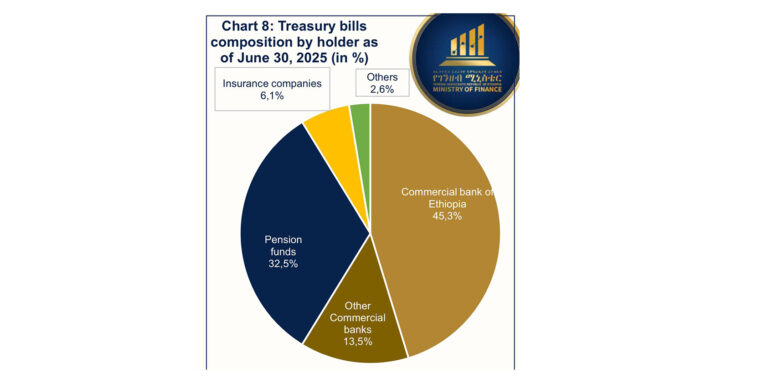
The National Bank of Ethiopia accounts for 27%, and pension funds hold 18%. This pattern is mirrored in T-bill holdings: CBE holds 45.3% of outstanding T-bills, followed by pension funds at 32.5%, and other commercial banks at 13.5%. Insurance companies hold 6.1%, while other institutions, including Ethiopian Investment Holdings, account for 2.6%.

The bulletin also highlighted key operational enhancements, including the trading of 182-day T-bills on the Ethiopian Securities Exchange (ESX) and the government’s transition toward fully electronic transactions. These initiatives aim to increase the market’s efficiency, accessibility, and reliability.

The government has announced plans to finance its budget deficit by borrowing from the market rather than taking direct advances from the central bank—a practice that has previously contributed to inflation.

For Ethiopia’s 2025/26 budget year, the approved budget of 1.93 trillion birr carries a deficit of 22%, amounting to 417 billion birr.

The government plans to finance this deficit through a shift to market-based mechanisms, relying on domestic sources such as Treasury bills and other instruments, alongside international budget support.

Great Ethiopian Renaissance Dam Completed: 91% funded by CBE loan

0

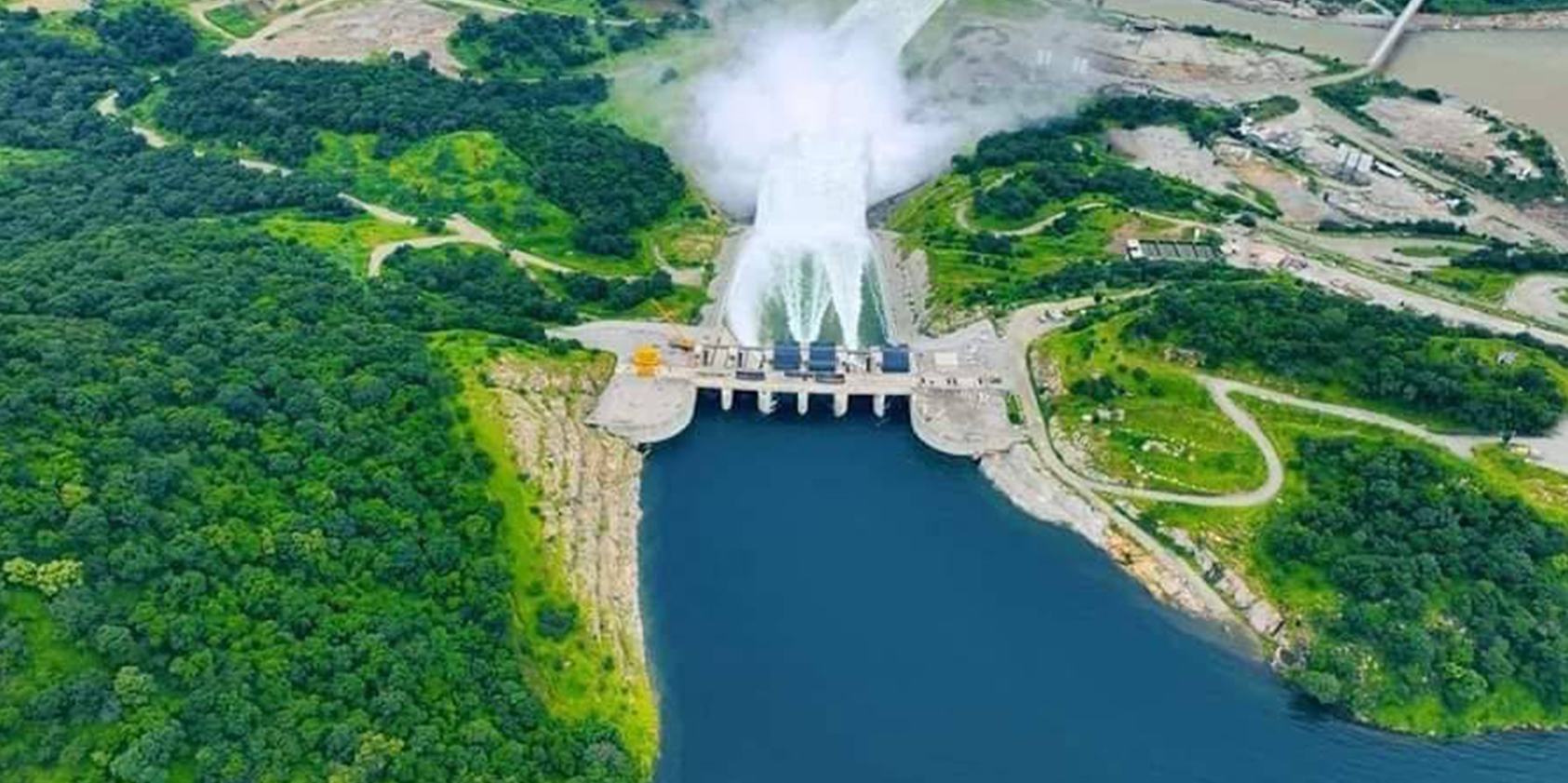
The Great Ethiopian Renaissance Dam (GERD), Africa’s largest hydroelectric project and a symbol of Ethiopia’s development and unity, has been completed after 14 years of construction and is set for inauguration on September 9, 2025.

Officials confirm that over 91% of the project’s total financing—approximately 223 billion birr—was provided through loans from the Commercial Bank of Ethiopia (CBE). The remaining 9%, about 23.8 billion birr, came directly from the Ethiopian people through bond sales and gifts.

Moges Mekonnen, Corporate Communication Director at Ethiopian Electric Power (EEP), described this financing model as unique and a reflection of Ethiopia’s commitment to self-reliance and national sovereignty. “The Great Ethiopian Renaissance Dam demonstrates to the world our strong desire to grow in our own capacity and protect our national interests without pressure,” Moges said.

The total project cost surpassed 233 billion birr and was fully covered by domestic sources, without reliance on foreign loans. Citizens contributed not only financially but also through mental, diplomatic, and physical efforts, underscoring national unity behind the landmark project.

Currently, GERD is already feeding 3,400 megawatts of power into the national grid. Once fully operational, it will generate over 5,225 MW or more than 15,670 gigawatt-hours annually, expected to generate more than $1 billion in revenue each year. The dam will significantly boost the economy by powering large industries and modernizing the service sector.

Besides electricity production, the GERD creates an artificial lake stretching 270 kilometers featuring about 70 islands, which have promising potential for tourism development.

The completion and upcoming inauguration of the GERD mark a proud milestone for Ethiopia, symbolizing its resilience and determination to achieve sustainable economic growth on its own terms. Heads of state and dignitaries are expected to attend the inauguration ceremony next week, marking a new era in Ethiopia’s energy and development landscape.

Central Bank Governor Resigns 

0

Mamo Esmelealem Mihretu, the Governor of the National Bank of Ethiopia (NBE), has resigned after more than two and a half years in office.

During his tenure, Governor Mamo led a period of significant financial reform, implementing essential macroeconomic policies and revising key banking legislation, including the new NBE establishment and banking business proclamations.

Financial experts suggest that his resignation may be connected to the recently enacted NBE proclamation, which formally establishes the central bank’s independence from the executive branch. This shift towards autonomy aligns with ongoing recommendations from the International Monetary Fund (IMF).

Efforts to reach Mamo, who is also a member of parliament, for comment were unsuccessful.

property prospecting notice

0

Office BuildingGENERAL INFORMATIONThe Delegation of European Union to Ethiopia and the Delegation of European Union to the African Union are looking for a new office building to gather both delegations in a single premise that meets the Standard Building Specifications of the European Commission and Security Requirements. This Property Prospecting Notice is intended to inform property market participants as well as any other interested economic operators about the property needs of the Delegation of the European Union to Ethiopia and African Union (the ‘Delegation’) in Addis Ababa, Ethiopia, and to collect information on properties and projects within a defined perimeter.The Delegation is looking for office space in diplomatic areas of Addis Ababa, Ethiopia, located in preferred locations of Sub-cities: Bole /Arada/Kirkos/ Lideta/Yeka/Nifas Silk Lafto and Kolfe Keraniyo.The Delegation office represents the image of the EU in a third country. It is often the first contact point with the EU for people in third countries. Delegation offices should therefore have a location with a good visibility and a building that presents an appropriate representative image. Hence, the office building’s location should be easily accessible and consistent with the needs of representation and visibility of an important diplomatic mission.The security of the Delegation buildings is one of the prime objectives of the EEAS. The security situation in the host country strongly influences the choice of the type of the office buildings, its location and the need for additional protection measures.The intended office building’s total above ground net surface area shall be between 3750 m² and 5700 m². The said area should include all areas in the premises such as offices, meeting rooms, reception area, corridors, entrance hall, internal staircases, elevators, archives, copy rooms, server rooms, kitchens, lavatories and specific security areas but exclude parking bays and areas exclusively dedicated to technical equipment. Reference shall be made to measurement code applicable to the buildings of the institutions and other bodies of the European Union, Version 01, Dated 29/11/2019 -Annex II.The premises/building required to meet the Delegation’s needs should preferably:be completed (or nearing future completion) and available for occupation by 26/02/2027 at the latest. Projects may also be considered, if appropriate;The compound must have all the necessary permits from the appropriate authorities and meet all requirements related to local laws, regulations, ordinance and codes in force at the time of its first occupation.should be accessible to persons with reduced mobility (including access to specially equipped toilets and evacuation means for emergency cases)be fitted out for office space. Base buildings (shell and core) may also be considered if the owners offer to fit them out as required before occupation by the Delegation;comply with the standard building specifications of the European Commission (http://ec.europa.eu/oib/pdf/mit-standard-building-specs_en.pdf) –Annex I.be suitable for accommodating 150 members of staff in single/shared offices and/or open spaces; including a meeting room, suited for hosting present member states at a time ( Lisbon Conference meeting Room (LCR) of minimum size 120m2)comprise description of offices/meeting/archive/storage/IT rooms and parking bays required. Reference shall be made to specifications for special-purpose zones in the Manual of Standard Building Specifications- (Annex III)The compound area should allow parking slots for at least to 90 vehicles. In addition, there should be enough space for the installation of electric vehicles charging stations, generators and other required utilities. See description in next section for parking space requirements.be ideally be located in diplomatic areas and in areas preferred by Member States’ and other embassies, close to the local ministries, international organizations and Residence, and at reasonable distance from the areas used for staff accommodation.PARKING SPACE REQUIREMENTSFor the security of staff and vehicles, the Delegation is required to provide secure parking areas for all service vehicles. In addition, the Delegation should normally have more parking spaces than service vehicles, to allow for staff coming to work in their own cars and for a number of visitors. Accordingly,The Delegation would like to have parking slots for at least to 90 vehicles. Additional parking spaces beyond 90 will be favourably considered during evaluation.The parking space infrastructure shall be accessible to the EU vehicles all the times and comply with applicable accessibility standards and regulations. It shall be with proper surface treatment, parking signage, lighting, clear delineation and numbering of slots.Electric vehicles are a new emerging sector in Ethiopia and with government’s plan to replace current gasoline vehicles with electric vehicles. Hence requiring installation of electric vehicle charging stations in parking lots. Noting the forthcoming scenario; installation with property owners and/availing space for delegation’s own installation shall be considered. There should be enough space for the installation of up to 10 electric vehicles’ charging stations. The charging stations will be for the exclusive use of the Delegation and shall be accessible all the time integrating modern payment systems and user-friendly interfaces.Preparing an office building for the special needs of a Delegation usually requires a significant investment, in particular in security measures. As a general rule, the EEAS prefers therefore long-term lease contracts for its office premises or – where economically advantageous and financially possible – the purchase or construction of its office buildings.The proposed building contract will be, as the case may be, either a lease agreement or a purchase and sale agreement executed in the name of the European Union (the ‘EU’). The contracting authority will be the European External Action Service (the ‘EEAS’).The administrative section of the Delegation will serve as contact point for property market participants and other interested economic operators. For further information, please contact the administrative section by email at DELEGATION-ETHIOPIA-PPN@eeas.europa.euPURPOSES OF PROSPECTING THE LOCAL MARKETThis notice aims to collect information about properties and projects, which can meet the Delegation’s aforementioned needs. The information collected will be used to identify those properties (or projects) suitable to the Delegation’s needs.If, on the basis of the information collected, the Delegation considers that all or part of the properties (or projects) offered can effectively meet its needs, it may launch a procurement procedure in accordance with Regulation (EU, Euratom) 2024/2509 of the European Parliament and of the Council of 23 September 2024 on the financial rules applicable to the general budget of the Union (recast).This publication does not constitute, nor should it be construed as, a commitment on the part of the EEAS in its procurement procedures.NOTIFICATIONAll property market participants and other interested economic operators owning or holding any property (or project) which can meet the Delegation’s needs are encouraged to notify the Delegation, by close of business on 10.10.2025, using one of the following methods:registered delivery, as evidenced by the postmark, to the following address:Delegation of the European Union to Ethiopia Postal address: Cape Verde Road, Bole Sub-city, Kebele 03, P.O. Box 5570 – Addis Ababa – EthiopiaTo the attention of: The Head of Administration Subject: Property Prospecting Notice –Office Building – Notificationhand delivery (in person or by any party representing the economic operator, or bycourier) to the following address::Delegation of the European Union to Ethiopia Postal address: Cape Verde Road, Bole Sub-city, Kebele 03, P.O. Box 5570 – Addis Ababa – EthiopiaTo the attention of: The Head of Administration Subject: Property Prospecting Notice –Office Building – NotificationOffice hours: 8:00AM – 5:15PM, Monday to Friday (except national holidays)electronic delivery to the following address:DELEGATION-ETHIOPIA-PPN@eeas.europa.euTo the attention of: The Head of Administration Subject: Property Prospecting Notice –Office Building – NotificationOnly those notifications received by the deadline stated above and including at least but not limited to the following information will be deemed as valid and considered by the Delegation:Identity of the owner/holder of the premises/building;Floor plans, sections, elevation drawingsDetailed description of the premises/building (including exact size of net surface area);spreadsheets of surfaces in square metersStatus of completion of the premises/building;Whether the premises/building are ‘for sale’ and/or ‘for rent’.Further details and reference of annexes specific to this property prospecting notice should be checked in the below link on the Delegation’s website. https://www.eeas.europa.eu/delegations/ethiopia/property-prospecting-notice-office-building_en?s=98