The seventh Ethiopian general election, held amid a range of challenges and eagerly awaited by much of the public, has reached a critical historical milestone. On Monday, June 1, 2026, millions of citizens went to polling stations to cast their votes.
This highly significant national electoral process will determine the 547 members of the House of Peoples’ Representatives and the composition of various regional councils. Ultimately, it will decide the executive leadership that will guide Africa’s second most populous country for the next five years.
As the country stands on the eve of election day, the public mood reflects a mix of anxiety, anticipation and cautious democratic hope. The National Election Board of Ethiopia (NEBE) has announced the completion of voter and candidate registration, signaling that the election’s administrative framework is officially ready. However, the road to this point has been far from smooth, marked by a clash between technological ambition and the harsh realities of the Horn of Africa.
Led by NEBE Chairperson Melatwork Hailu, the electoral process has served as a test of institutional resilience. From deploying a hybrid digital voter registration system to enduring severe logistical shortages, network disruptions and security challenges in some regions, the Board navigated numerous obstacles in reaching the mandatory campaign freeze known as the “quiet period.”
Civil society organizations working on elections and related issues say this election marks a bold step forward. It is the first time in modern Ethiopian history that a digital voter registration infrastructure has been implemented on such a wide scale.
While the digital transition promised greater transparency and protection against traditional ballot-box fraud, it quickly collided with Ethiopia’s technological and infrastructural realities. From network outages to complex court battles among fragmented political parties, the Election Board was forced to push through systemic vulnerabilities to deliver a credible election to the public.
A defining feature of this seventh general election is the digital voter registration system introduced by the Board for the first time, using tablets and a mobile application named Mirchaye (“My Election”). Launched in early January 2026, the system was designed to eliminate duplicate registration, reduce human error and ensure an unalterable digital record. The Election Board envisioned a future in which voters could bypass long queues and administrative bottlenecks by registering from home using their Fayda national ID data.
However, during the voter registration period, which ran from March 7 to April 22, 2026, this carefully designed blueprint collided with the country’s infrastructural reality. The Board openly acknowledged that network disruptions, loss of connectivity and other systemic hurdles prevented the system from functioning as intended.
The transition from manual paper ledgers to a centralized digital registration platform was seen as a revolutionary step for the Election Board. By moving registration online and tracking data through modern tablets at polling stations, the Board aimed to eliminate ghost voters, double registration and manual data manipulation.
In response to the early setbacks, the Election Board introduced an emergency hybrid procedure, reverting to manual paper registration in areas where the digital infrastructure collapsed under pressure. To make up for lost time due to technical disruptions and subsequent adjustments, the Board extended the voter registration period by 14 days.
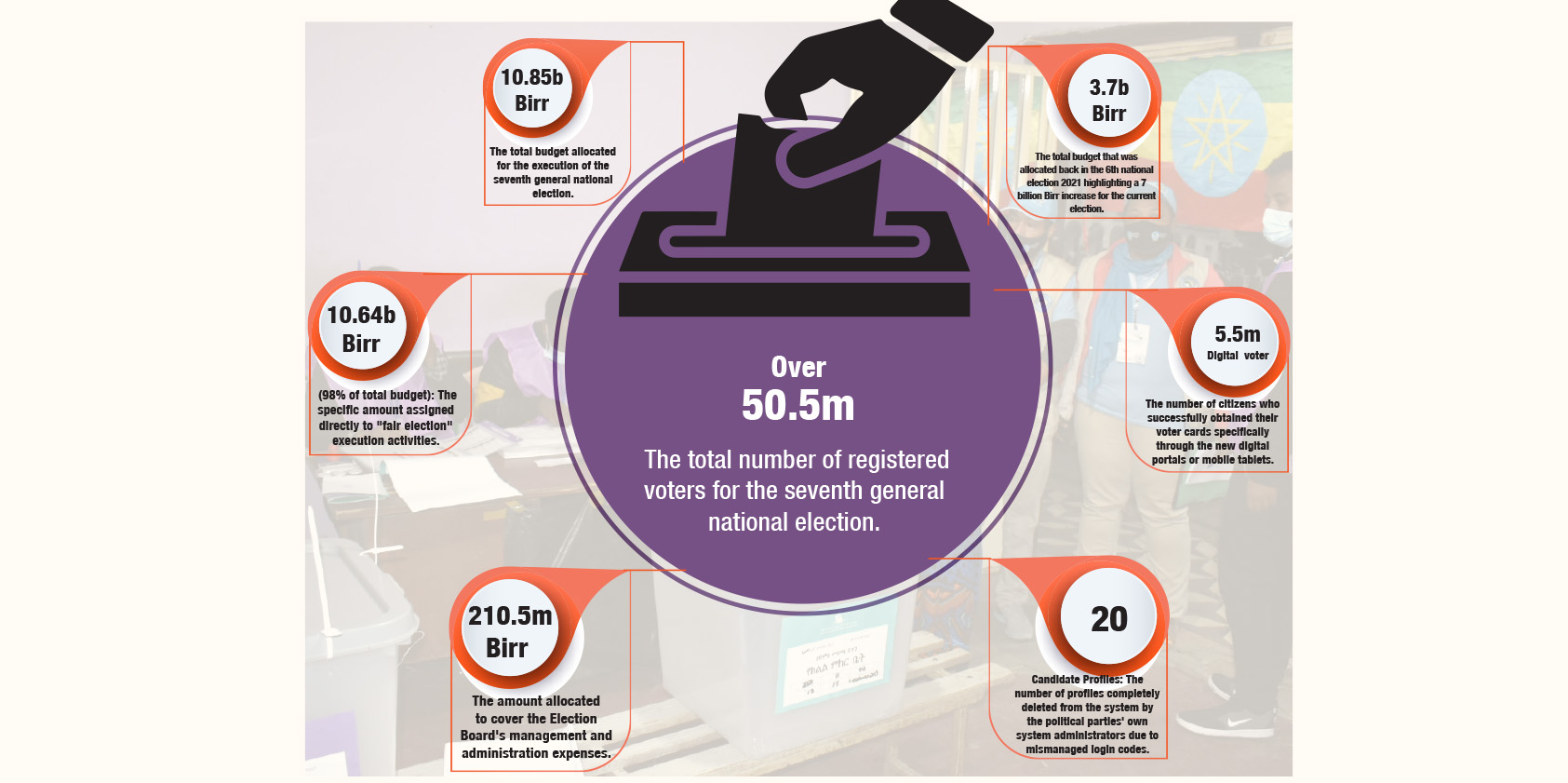
Melatwork Hailu explained that although the system was achieved through great effort, it had produced remarkable results, with nearly 5.5 million citizens successfully obtaining their voter cards either through the digital portal or through tablets deployed at polling stations.
According to NEBE, a budget of more than 10.85 billion birr was allocated for the seventh general election, while the total number of registered voters reached more than 50.5 million.
Based on data released by the Board, the lion’s share of the election budget — 10.64 billion birr — was assigned directly to election implementation activities. This accounts for 98 percent of the institution’s total budget. The remaining 210.5 million birr was allocated to management and administrative expenses.
The amount set aside for this election is about 7 billion birr higher than the budget for the sixth national election held in 2021. In that election, the total budget was 3.7 billion birr.
In addition to the budget allocation, the Election Board confirmed that 50,514,155 voters were registered for the seventh general election, suggesting broad public participation.
A total of 47 political parties are taking part in the election, and 10,934 candidates have been fielded for various council seats. Despite the operational recovery, independent assessments and public commentary have pointed to several critical vulnerabilities that affected the registration process.
Civil society organizations and political actors expressed concern about structural flaws. The Election Board later explained that the disruptions were caused by frequent interruptions in the digital registration system in both urban and rural constituencies, the mistaken establishment of a small number of registration stations in legally restricted areas, instances of unverified and proxy registrations without physical presence, and a high number of stations lacking basic infrastructure for persons with disabilities.
If voter registration was a battle against network infrastructure, candidate registration became a demonstration of the rigidity of technology-driven legal systems. Ahead of the election, competing parties complained that the process was designed to exclude them. In response to allegations that hundreds of candidates had been intentionally excluded through human intervention, the Election Board said the system operates without human interference during the initial data-entry phase.
According to the Chairperson, when a candidate’s profile fails to meet specific legal requirements, the system flags the rejection automatically and returns it to the respective party’s system administrator along with a detailed explanation of the missing documents.
According to Election Board data, of the 42 registered political parties, only nine had candidates rejected, with a total of 80 individuals affected.
Election Board leaders said the strength of the current system lies in its transparency. At any time, an auditor or political stakeholder can examine the system logs. It is possible to see who logged into the system, what document was uploaded, why the system rejected it and the exact time of the action. According to the Board, no human hand is involved in that stage.
The Board also said nearly 20 candidate profiles were deleted from the system not by the Election Board, but by the parties’ own system administrators, who failed to manage their login codes properly. It said that if those parties had corrected the document errors and clicked “resubmit” before the deadline, all 80 candidates would have received their certificates.
Although the logistics proved resilient, Ethiopia’s geopolitical realities have placed limits on the democratic exercise. The Election Board said it conducted a comprehensive and dynamic security assessment across the federation to determine where a safe and credible vote could be guaranteed.
Following assessments by security institutions, independent observer groups and local administration bodies, all 38 constituencies in the Tigray region remained suspended for the seventh election.
This is because tensions between the federal government and the Tigray People’s Liberation Front (TPLF) remain unresolved, and reports indicate that the former leadership is attempting to regain control of power, which competing parties say risks undermining the fragile 2022 peace agreement that ended the devastating civil war.
Due to volatile security conditions that pose a direct threat to voters and election workers, eight constituencies in the Amhara region were also excluded from the election cycle. The Amhara region is grappling with the Fano militia, which has seized control of much of the countryside and is engaged in widespread fighting with the Ethiopian National Defense Force (ENDF).
The Board emphasized that these exclusions do not amount to permanent disenfranchisement. Its mandate allows it to conduct delayed and localized elections as soon as security conditions stabilize and human rights conditions permit.
Conversely, the Board said that following successful security interventions, it opened polling stations and registered voters in several zones within Amhara and Oromia, as well as in Central Ethiopia, areas that had previously been restricted.
To ensure the credibility of the process, the international community has also mobilized. High-level observer delegations from the African Union and IGAD have been deployed. Led by former Kenyan President Uhuru Kenyatta, the African Union Election Observation Mission arrived in Addis Ababa with 73 observers drawn from 37 African countries.
Similarly, the IGAD delegation, led by former Ugandan Vice President Speciosa Wandira-Kazibwe, deployed 26 short-term observers to monitor election-day proceedings.
As Ethiopians cast their votes, economic survival weighs heavily on their minds. The election is taking place amid what the Nordic Africa Institute has described as a “growth paradox.” Although the International Monetary Fund estimated that Ethiopia’s economy grew by about 9.2 percent in the 2024/25 fiscal year, driven by mining, construction and manufacturing, ordinary citizens are still grappling with rising public debt and severe foreign-exchange shortages.
After defaulting on a major international Eurobond, the country is now restructuring its external debt under the G20 Common Framework. While export commodities such as coffee and gold have shown recent improvement, a sharp rise in global fuel prices has placed enormous pressure on import-dependent sectors.
An economic analyst described the country as “facing an election without energy,” arguing that while the government promises stability through IMF-led reforms, “it stabilizes balances, but not necessarily production. It stabilizes creditors, but not necessarily citizens.”
Although the election outcome could be a major victory for Prime Minister Abiy Ahmed’s Prosperity Party, which currently holds 457 of the 547 parliamentary seats, it will face sharp criticism if it fails to deliver tangible improvements in the cost of living.
The government that emerges from the June election is expected to focus on three main priorities over the next five years: financial stabilization, transitional justice and making digital governance accessible to all citizens.