

Magical thinking is becoming quite broad and frighteningly popular. When magical thinking pervades a society, widespread disconnect, followed by actively erupting disillusionment, is the inevitable result. By and large, we believe the imports of these make believe phenomenon/magical thinking, in all spheres of socio-economic existence, is essentially due to the strategy of globally entrenched interests. All the major institutions of humanity are systemically geared to numbing the masses. It is not for no reason we affectionately call the ‘human mass’ of each and every society the ‘sheeple’ (sheep + people). Without the project of zombifying the sheeple (sorry for the redundancy) the world’s dominant interests cannot always get away with their ritualized murdering, so to speak!
Here is a benign general definition. ‘Magical thinking is a type of thought process based on questionable cause and effect relationships. This can lead a person to hold false ideas and make poor decisions. In some cases, magical thinking plays some type of positive role that improves creativity or quality of life’. For us, a more nuanced and biting explication of the phrase is preferred, subsequently; ‘Magical Thinking’ is nothing more than a type of thinking fixated almost always on the magical, i.e., on the irredeemably irrational. In other words, it is thinking ‘outside of reality’! If magical thinking is widespread in a society, the possibility of rational thinking usurping power, hence responsibilities, is going to be remote. Such a situation is now prevalent in the majority of human collectives/societies. Why is the world having more and more individuals, people, corporations, states, etc., immersed in magical thinking? Our answer is simple; it is because late modernity is incapable of surviving actually existing reality! See the articles next column, on pages 30.
Let’s use current and somewhat familiar examples to illustrate the point. In Ethiopia, private banks profess to pay a dividend of 50% per annum. Obviously, this is not a prudent business model, by any stretch of imagination. Elsewhere, such Ponzi utterances can easily start a bank run, but not here. It seems there is no room for rational reflection on such critical matters in our country. Be that as it may, it is obvious that banks play significant role in late modernity. Therefore, if banks are getting such basic fundamentals wrong, then one can imagine what kind of blunders other gullible economic actors are liable to make, invariably at the expense of the sheeple’s livelihood. Between our mighty industrialists, who are bravely assailing the formidable manufacturing challenge of bottling God given water in plastics, and the highly depraved tenderpreneurs/rentiers corrupting all state apparatus, the country’s hope of creating a capable modern sector is bound to remain only a pipe dream. But don’t sweat it too much; what we lack in creativity can be amply compensated with our unfailing magical thinking!
Less than half a decade ago, the Ethiopian government was going around boasting that it had managed to raise a couple of billions of USD from the international capital market without a glitch. If memory serves us right, the underwriter/handler was Goldman Sachs. To critical analysts the whole theatrics seemed embarrassingly amateurish, if not out rightly imbecilic. As usual, we opined against such magical thinking, but to no avail. The magical thinking, backing the government’s decision was the unfounded belief in the country’s capacity to service the debt as well as pay the principal without sweat, i.e., without rescheduling or (anticipated) debt forgiveness. With plenty of useful idiots around (from the lenders’ point of view), our voices were drowned swiftly. Nonetheless, we fruitlessly continued to holler; these useless idiots (our sentiment) have no clue as to the real workings of transnational capital, financial, industrial, etc. Highly educated all the way up to complete daftness and subjugation, these cretins/useless idiots and their preaching were accepted as the epitome of erudition. Beware of false Prophets in late modernity, says the Good book!
Trusting the Goldman Sachs of this world, on its own, is an example of unadulterated magical thinking. These so-called investment banks (before they collapsed in 2008 and changed their status to ordinary banks) have proved, time and again, their unreliability the world over. Greece was taken to the cleaners, never to recuperate, on the account of Goldman Sachs’ expensive ‘guidance’. During the last decade Africa was ordered to sing the tune; ‘it is time for Africa’ or in the parlance of the propagandists; ‘Africa Rising’, all on the back of another cyclical commodity boom, which was known to be short lived. Today, we are not singing but crying. Don’t expect our good for nothing elites/leadership (not only political) to self-flagellate for their gross mistakes. If anything, these states and their leaders are now working, yet again, on other unworkable projects (New Green Development, Sustainable, blah, blah.), mostly to collect pittance from the pushers of these initiatives (OECD countries)!
Truth is; when the sheeple starts thinking magically, it tends to feel good.
Achieving all our dreams through sheer desire is what one of the modern day philosophers from Hollywood’s ivory tower is advocating. “I operate from a place of delusion – that’s what the Fame is all about….I want people to walk around delusional about how great they can be-and then to fight so hard for it everyday that the lie becomes the truth.” Good Day!
MAGICAL THINKING
Jubilation as the first phase of GERD filling completed
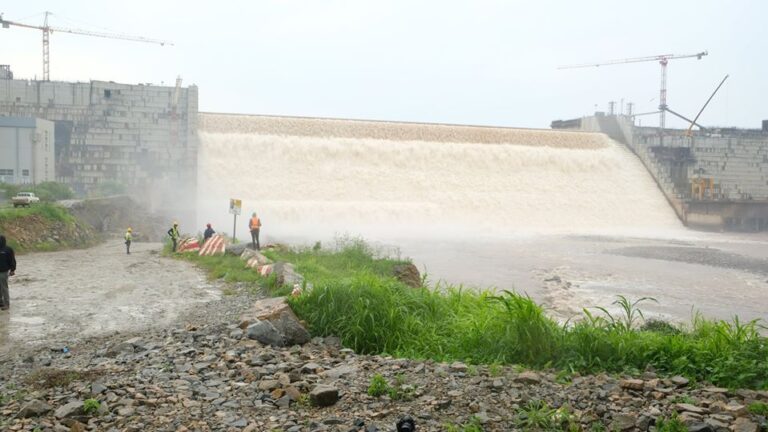
On Sunday July 19 at exactly 10:00 pm the first phase of the filling of the Grand Ethiopian Renaissance Dam (GERD) was completed. After that Prime Minister Abiy Ahmed congratulated all Ethiopians on the completion of the first phase of the filling of GERD on July 21. The country glows with proud moment where everyone walks with their heads high the following day.
Many took it to the social media to announce their excitement. “Beautiful view, It is really great, This is historic achievement, congratulations Ethiopia,” tweets by the name Idris M. Sanusi from Nigeria. “Ethiopia has the right to use Nile waters because 86% of waters originates from Ethiopia. Nile dam in Ethiopia is my dam! Its my dam! Ethiopia deserves a fair share!” wrote another by the name Belay.
Some weeks back Prime Minister Abiy had justified the start of filling the Renaissance Dam due to the heavy rainfall season. Capital also wrote the start of the filling of the GERD two weeks back saying that it started on July 8.
The idea of a massive hydroelectric project on the upper Nile River, in the Ethiopian highlands, has been a dream since the days of Ethiopian Emperor Haile Selassie in the 1960s. But it wasn’t until 2011 that the Grand Ethiopian Renaissance Dam got underway in earnest-and ever since, relations with the downstream countries Sudan and Egypt have been fraught. For Ethiopia, whose citizens bankrolled the USD4 billion+ project, the dam is not just a way to provide electricity to a power-starved corner of the continent but has become a point of national pride and emblematic of the country’s ambitions as a regional power.
The massive dam, Africa’s biggest, has become a flash point of geopolitical tensions between Egypt and Ethiopia. However During the last 12 days of the filling resident in Cairo told Capital that they have not seen any significant change on the Nile in Cairo. “I have been living here for many years, and I always cross the Nile to commute to work, and in those days I have not seen anything unusual in the Nile,” said one resident of Cairo who asked anonymity.
Ethiopia made it clear that it would continue the dam project despite lingering disagreements with other Nile-dependent countries, and in fact it began filling the massive reservoir behind the dam this month, taking advantage of Ethiopia’s rainy season. Egyptians fear Ethiopia will fill the dam over a period of just a few years, which could choke off water supplies that Egypt needs downstream, especially for agriculture. The Ethiopian government says the pace of filling shouldn’t affect Egypt’s allotment of water, and it further maintains that Egypt has used more Nile water than it’s entitled to for decades.
Thermometer guns in the country gravely incorrect
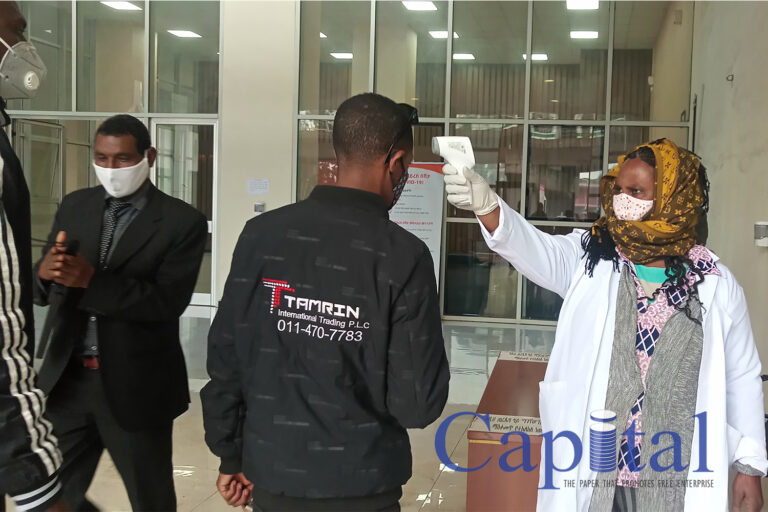
Thermometer guns has become an iconic image of the coronavirus outbreak in the world and in Ethiopia: a masked official aiming what appears to be a small white pistol at a traveler’s forehead. In our case apart from the officials at airports, security guards at every hospital, office, business center, bus station, mall and hotel will hold the gun to your head to screen people for fevers so as to prevent the spread.
The device is equipped with an infrared sensor that can quickly measure surface temperature without making any contact with a person’s skin. In recent years, it has become an important tool for countries scrambling to contain viral outbreaks. It was widely used to try to slow the spread of SARS and to curb the Ebola outbreak.
Thermometer guns are said to be unreliable outside carefully controlled health care settings, according to medical officials and experts on infrared devices.
According to Tigistu Adamu (MD), an advisor at the Ministry of Health, the devices need series calibration to be reliable. “The devices cannot be precise in certain environments or when someone has taken medication to suppress fever,” Tigistu said.
“Once the thermometers start to show inaccurate information the device need to be calibrated otherwise it will continue providing false information.”
Since the devices are distributed all over the country it is difficult for the ministry to control all, as Tigistu said.
The thermometers determine temperature by measuring the heat emanating from the surface of a person’s body. Often, however, those wielding the tools don’t hold them close enough to the subject’s forehead, generating unusually low temperature readings, or hold them too close and get a high reading.
“My temperature was often below 35 degrees Celsius when these temperature guns screen my temperature wherever I go, be it a hospital or a restaurant. This is a joke,” one person said after Capital approached him while he was arguing with security guards at a bank when they told him that the gun reads his temperature as 33 degree Celsius. Moreover Capital’s reporter tried to see readings around the city and those who use the device.
“We are told that if the gun measures above 37.5 degree Celsius we have to report that person to authorities, but no one told us what the lowest number can be. We will let inside anyone who is below 37.5 degree Celsius. We mostly get a measurement of 33 degree Celsius to 34.5 degree Celsius,” one security guard at a restaurant told Capital.
It is now common to see erroneous information of temperature guns generating unusually low temperature readings as the person is dying of hypothermia or sometimes high temperature. Typically between 36.1 and 37.2 degree Celsius is considered as the normal temperature for a human being.
Hypothermia is a medical emergency that occurs when your body loses heat faster than it can produce heat, causing a dangerously low body temperature. Normal body temperature is around 37 degree Celsius. Hypothermia occurs as your body temperature falls below 35 degree Celsius.
Over 10,000 health workers in Africa infected with COVID-19

Cases in Africa surpass 788,000
The World Health Organization (WHO) announced that more than 10,000 health workers in the 40 countries which have reported on such infections have been infected with COVID-19 so far, a sign of the challenges medical staff on the frontlines of the outbreak face. The total number of coronavirus cases across Africa has also climbed to 787,501 as of Friday July 24 according to the Africa Centres for Disease Control and Prevention.
This comes as COVID-19 cases in Africa appear to be gathering pace. There are now more than 750,000 cases of COVID-19, with over 15,000 deaths. Some countries are approaching a critical number of infections that can place stress on health systems. South Africa is now among the worst-hit countries in the world.
“The growth we are seeing in COVID-19 cases in Africa is placing an ever-greater strain on health services across the continent,” said Dr Matshidiso Moeti, WHO Regional Director for Africa. “This has very real consequences for the individuals who work in them, and there is no more sobering example of this than the rising number of health worker infections.”
So far, about 10% of all cases globally are among health workers, though there is a wide range between individual countries. In Africa, information on health worker infections is still limited, but preliminary data finds that they make up more than 5% of cases in 14 countries in sub-Saharan Africa alone, and in four of these, health workers make up more than 10% of all infections.
Inadequate access to personal protective equipment or weak infection prevention and control measures raise the risk of health worker infection. Surging global demand for protective equipment as well as global restrictions on travel have triggered supply shortages. Health workers can also be exposed to patients who do not show signs of the disease and are in the health facilities for a range of other services. Risks may also arise when health personnel are repurposed for COVID-19 response without adequate briefing, or because of heavy workloads which result in fatigue, burnout and possibly not fully applying the standard operating procedures.
In many African countries infection prevention and control measures aimed at preventing infections in health facilities are still not fully implemented. When WHO assessed clinics and hospitals across the continent for these measures, only 16% of the nearly 30 000 facilities surveyed had assessment scores above 75%. Many health centres were found to lack the infrastructure necessary to implement key infection prevention measures, or to prevent overcrowding. Only 7.8% (2213) had isolation capacities and just a third had the capacity to triage patients.
In related development the total number of coronavirus cases across Africa has climbed to 787,501, the Africa Centres for Disease Control and Prevention said.
The death toll from the virus in the continent reached 16,697, the latest figures indicate, while a total of 446,082 patients have recovered so far.
The Southern Africa region has recorded 424,200 cases, North Africa 143,300, West Africa 114,000, East Africa 61,800 and Central Africa 42,200.
At least 6,400 people have died in Southern Africa, 6,100 in North Africa, 1,800 in West Africa, 1,500 in East Africa and 871 in Central Africa.
More than 241,600 patients have recovered in Southern Africa, 72,800 in West Africa, 69,600 in North Africa, 34,200 in East Africa and 27,800 in Central Africa.
“One infection among health workers is one too many,” said Dr Moeti. “Doctors, nurses and other health professionals are our mothers, brothers and sisters. They are helping to save lives endangered by COVID-19. We must make sure that they have the equipment, skills and information they need to keep themselves, their patients and colleagues safe.”
WHO has been working closely with health ministries to reduce health worker infections since the outbreak began. The Organization has trained more than 50,000 health workers in Africa in infection prevention and control, with plans to train over 200,000 more, as well as providing guidance documents and guidelines on best care practices and the most up-to-date treatment regimes.
WHO is also helping to fill gaps in the supply of personal protective equipment. Currently, 41 million items of personal protective equipment are ready to ship from China to cover the needs of 47 African countries. Shipments for an initial set of 23 African countries are planned to start during this weekend.
As a result of concerted efforts by WHO and partners some African countries have managed to reduce health worker infections considerably. For example, two months ago over 16% of COVID-19 infections in Sierra Leone were among health workers. The figure has now dropped to 9%. Cote d’Ivoire has reduced the proportion of infections among health workers from 6.1% to 1.4%. Scaling up infection prevention and control measures can further reduce infections among health workers.
