As shipping routes through the Strait of Hormuz and the Red Sea remain volatile, regional demand for locally produced aluminum is rising, creating a new export opportunity for Ethiopia’s growing manufacturing sector.
Tekhaf Aluminum, a relatively new industrial player based near Mekelle, says it is transitioning into a strategic export phase after receiving strong purchase interest from South Sudan, Uganda, and Mozambique. The company, which began large‑scale production only nine months ago, is now positioning itself as a regional supplier of construction‑grade aluminum in a market that has become accustomed to long waits and high costs for imports from Asia.
The disruptions to traditional maritime corridors have altered how East African builders and contractors source materials. With shipments from China exposed to unpredictable delays and surging freight costs, neighboring countries are increasingly turning to nearby producers. Getahun Tilahun, Sales and Marketing Manager at Tekhaf, told Capital that the closure or repeated disruption of key trade routes such as the Strait of Hormuz has not only triggered global supply shocks but also driven aluminum prices higher and created shortages in African markets.
“Middle Eastern countries produce about 9 percent of the world’s aluminum,” Getahun explained. “When transit routes are blocked, both the export of finished metal products and the supply of raw materials like alumina are disrupted. That is creating a favorable environment for Ethiopia to emerge as a regional supply hub.”
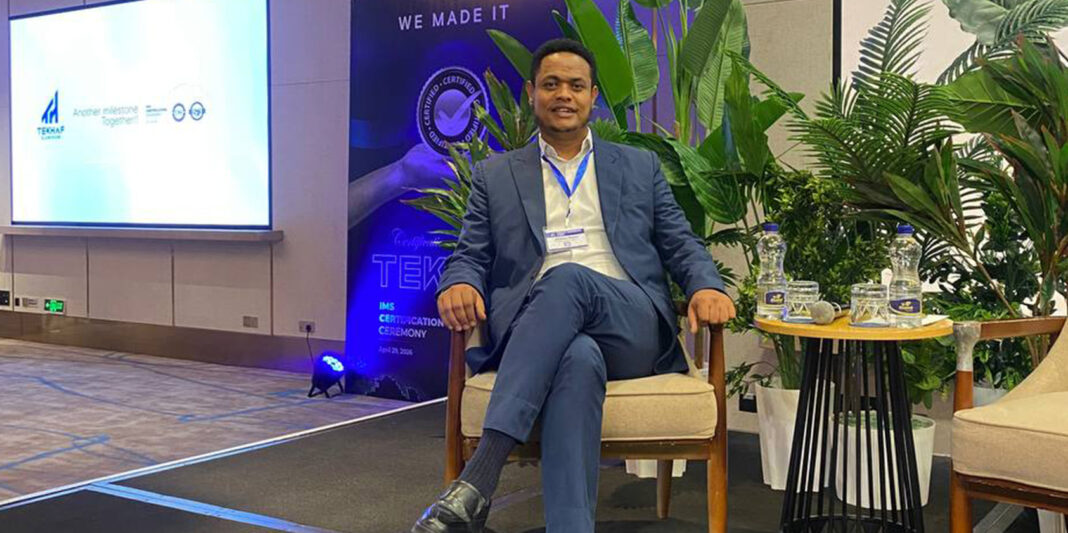
Near‑term demand has started to materialize. The company has received formal requests from South Sudan, Uganda, and Mozambique for standard aluminum sections, with buyers indicating they are ready to take delivery in high tonnage volumes. Before Tekhaf could engage regional partners seriously, it needed to pass international quality checks, most notably the ISO certification process. The company now reports that it has secured four major international standards: ISO 9001:2015 for quality management, ISO 14001:2015 for environmental management, ISO 45001:2018 for occupational health and safety, and accreditation from the Ethiopian Conformity Assessment Enterprise.
“In the international market, it is not enough to simply say your products are of high quality,” Getahun said. “You must be verified by an independent body. By going through the ISO process, we have moved beyond a ‘local shop’ mindset and are now approaching African buyers with the confidence that our products meet recognized international standards.”
Tekhaf’s 2026‑standard vertical powder‑coating facility gives the company an edge in surface finish and durability. With an annual production capacity of over 15,000 metric tons—more than 45 tons per day—the plant can manufacture aluminum sections up to 4.5 millimeters thick, suitable for large facade projects and high‑rise buildings such as the Commercial Bank of Ethiopia headquarters and Zemen Bank. Until recently, such sections were imported from China because no local firm met the technical specifications; Tekhaf now says it has filled that gap.
The manager also highlighted the company’s use of LPG gas in the manufacturing process, which helps maintain the straightness of the sections and prevents color fading—addressing common complaints about imported aluminum that can warp or discolor over time. The adoption of an integrated management system (IMS) further strengthens Tekhaf’s profile, linking raw‑material handling, quality control, and final product delivery under a single framework.
Despite these advances, the company faces structural constraints. The conflict in northern Ethiopia delayed the full start of operations, and the plant has only been running at about two‑thirds of its 45‑ton‑per‑day capacity. The main bottleneck is foreign exchange. Since aluminum billets and some key inputs come from China, shortages in hard currency have held back production. The company says it now employs more than 300 workers, most of whose salaries, raw‑material imports, and utility costs are foreign‑currency‑indexed.
“To be honest, the government has improved its foreign‑exchange‑allocation policy; without that support, we would not be able to keep our employees or stay in business,” Getahun acknowledged. “But to meet the kind of regional demand we are seeing, especially from Mozambique, South Sudan, and Uganda, we need a more stable and predictable supply of raw materials.”
To reduce dependence on foreign billets, Tekhaf is building an integrated smelting plant that will melt aluminum scrap and related metals into standardized billets. The facility is designed to insulate the company from global supply‑chain volatility and, in the longer term, position Ethiopia as a regional hub for finished and semi‑finished aluminum products. If the smelter comes online as planned, the firm could not only increase its internal capacity, but also begin supplying billets to other regional manufacturers.
For now, the convergence of geopolitical disruption, regional infrastructure needs, and Tekhaf’s new quality certifications is creating a window of opportunity. By turning regional trade bottlenecks into a business model, Ethiopia’s emerging aluminum sector is signaling that, even amid global supply shocks, a “Made in Ethiopia” label can now be a viable alternative in the African construction market.